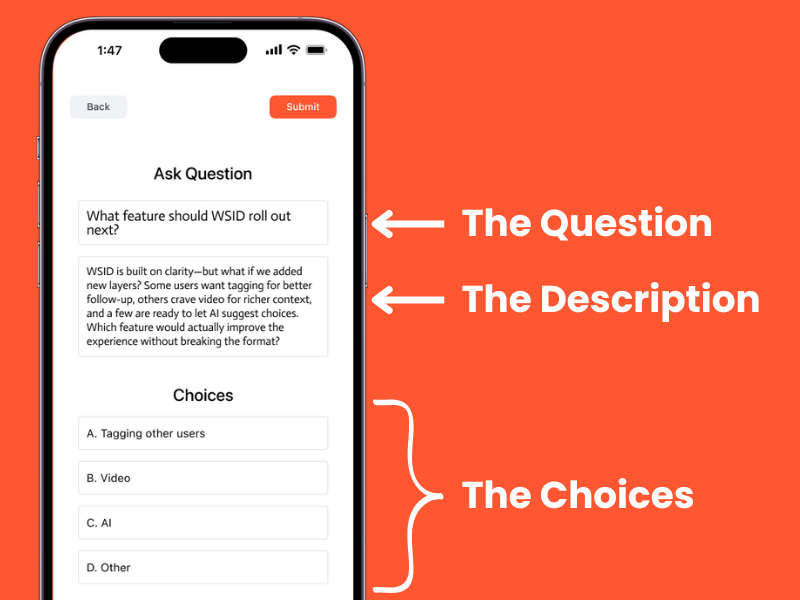
In a world of endless comment threads, random hot takes, and doomscrolling, WSID offers something different: structured clarity. Every post on WSID is built around a question – but not just any question; one with context, intention, and choices.
This structure isn’t accidental. It’s what makes WSID a social platform for people who want more than noise. In this post, we’ll break down the anatomy of a WSID question, and why it matters.
🔍 What Makes a WSID Question Different?
WSID isn’t built for passive posting. It’s not about dropping a quote or sharing a cat pic (though we love both). It’s about asking something that invites real insight. You can absolutely ask:
“What quote should I get tattooed on my butt?” or “Which cat photo should I put on my tee shirt?”
But you’ll need to do a little more than just post the image. You’ll need to structure the question. That’s where the anatomy comes in.
🧩 Part 1: The Question
We’ve already explored how to ask better questions on WSID, but it’s worth repeating: clarity is everything.
Some posts bury the question deep in a paragraph. Others hint at it without ever asking it directly. WSID flips that. Every post starts with a clear, direct question—whether it’s serious, trivial, or just plain weird.
Examples:
- “Should I take a gap year before grad school?”
- “Is it worth switching to a flip phone for my mental health?”
- “Which fast food restaurant has the best french fries?”
- “Shoud I join the gym or work out from home?”
If your question isn’t clear, your insight won’t be either.
🧠 Part 2: The Description
This is where you give users the backstory or add context. Not every question needs it, but many do. Some questions should not be presented in a vacuum. The description provides additional information so users have more things to consider.
Only the question and description appear on the WSID Dashboard, so this is your chance to frame the conversation. The better the context, the better the responses.
Example of a question that needs context:
Question: “Should I quit my job?”
Description: “I’ve been at this company for 6 years. The pay is good, but the culture is toxic. I have a potential offer lined up but it’s a startup with less stability.”
Example of a question that doesn’t need context:
“Which sneakers should I get?”
For visual questions like the shoe example, the only thing that is probably needed is a picture with each choice. Eventually, we may implement video and/or voice, but for now, we’re keeping things simple with images.
🎯 Part 3: The Choices
WSID limits choices to keep things simple. You get 2–4 options, each with a tight character limit. Why?
- It forces clarity
- It avoids rambling
- It keeps the focus on the decision
The long explanation? That belongs in the description. The choices should be clean, direct, and vote-ready, but they can also be open-ended to invite additional commentary.
Examples:
- Maybe
- Need more info
- Who cares
- Neither
- Other
- It depends…
We believe that 2–4 choices is the sweet spot. More than that, and users get overwhelmed. Fewer than 2, and it’s no longer mathematically a choice.
The choices are narrow and structured, but the content within each choice can be broad and open-ended. That’s what makes WSID flexible without losing clarity.
🧪 Why This Structure Matters
WSID isn’t trying to be a virtual town hall with hundreds of vague comments and a few nuggets buried deep. There are places for that, just not here. WSID asks users to think critically, frame their question clearly, and offer structured choices. It takes a little extra work, but it’s intentional; and that structure doesn’t just help the person asking. It helps everyone answering, too.
When questions are clearly framed and choices are well-defined, users can respond more thoughtfully, compare options more easily, and contribute insight without wading through ambiguity. We believe that leads to better insight, more productive conversations, and a platform that feels less like noise and more like meaningful dialogue.
💬 Final Thoughts
WSID is for people who want to ask better questions and get clearer answers. Whether you’re picking out your next tattoo or navigating a breakup, the structure helps you move from chaos to clarity.
Want to see how it works in action? Explore WSID now →